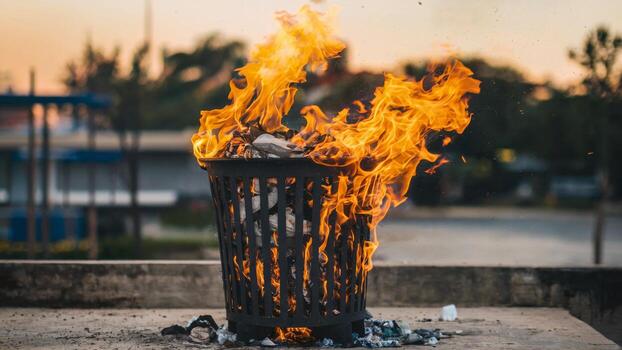
A trash can sits in the middle of the street. Tongues of flame swell upwards, plastic sags, melts and blackens and a circle of pavement glows in orange and red in the evening light. There is nothing symbolic or metaphorical about this moment. This all takes place in the real world, it is simply a trash can burning and there are people around who feel its heat, see its glow and smell its sharp chemical smoke.
This world does not last very long because someone films it. The moment it enters a phone the trash can is set loose into the realm of signs. The caption under the clip claims a political group lit the trash can. Maybe Antifa, maybe a nationalist militia or perhaps a disenfranchised teenager. Soon enough the video circulates everywhere from Reddit threads to Facebook groups to WhatsApp chats to news channels. Within a few hours the fire has suspects and a motive.
Jean Baudrillard saw where this leads. Once a thing becomes a symbol, it starts to come loose from the world it came from. The trash can that melted in the street is now a screen-sized icon, and it means something different to everyone who sees it. It has left its street and its town behind. It has become a sign, and the sign ends up having more influence than the trash can ever did.
When we watch that burning trash can online, what we react to is the meaning the caption and the context have given it. Whether the caption is wrong, or the video is mislabeled or doctored, makes little difference. People feel something, draw a conclusion and come away a bit more sure of what they already thought. In that sense the burning trash can says a lot about the world we live in now, where images travel faster than facts and often take their place.
Then the story takes on a life of its own. One side holds it up as proof that society is falling apart. The other side holds it up as proof that the media will blow anything out of proportion. The fire itself hardly comes up. It has become a placeholder for whatever people already believed.
By now the actual fire has been out for a long time, and the idea of it is doing all the work. This is what Baudrillard means by simulation. What happened in the street (who lit it, how long it burned) has been replaced by something that lasts much longer: a trash can burning in the imagination of millions of people who never stood near it. Once it has been framed and shared enough times, it is more real as an image than it ever was as an object.
Push this far enough and you get what he calls hyperreality, where images no longer refer to anything outside themselves. They start producing their own truths and their own consequences. The image of the fire ends up mattering more than the fire itself, and it gets absorbed into political talking points and people’s gut reactions.
The question of whether it happened drops away, and the argument moves on to what it means.
More and more, we live among framings of events rather than the events themselves. Tomorrow it will be a different trash can, but the pattern will be the same. Something happens, someone films it and explains it, and then the explanation swallows the thing. Baudrillard borrows a story from Borges here, about a map so detailed that it covers the whole empire. In his version, the map outlasts the land it was drawn from. The map doesn’t just represent the territory. It replaces it.
The world outside our screens still exists, but fewer of us spend our time there. The real fire went out in minutes. The one in people’s heads is still going, and it doesn’t need anything from the street to keep it lit.
In Simulacra and Simulation, Baudrillard describes this slide in four stages, and the trash can fits them fairly neatly.
Step 1: The real event A trash can is set on fire. People nearby feel the heat and smell the plastic, and someone might go looking for an extinguisher. For a moment there is only the fire itself. In Baudrillard’s scheme, this is the image as a faithful reflection of something real.
Step 2: The representation Someone films it and posts it with a caption: “Antifa set a trash can on fire in town today.” Now the fire comes with a label and a motive attached. The clip still shows something that happened, but through someone’s lens. This is his second stage, where the image masks and distorts what really happened.
Step 3: The simulation A day later the clip is being argued over by thousands of people who never saw the fire. Some say it proves lawlessness, some say it’s fake, and some don’t much care who lit it as long as it fits what they already think. The event has become secondary, and what matters is how it circulates. At this stage the image hides the fact that there is barely anything real left behind it.
Step 4: Hyperreality Once the symbol is strong enough, nobody needs real trash can fires anymore. Politicians can say antifa is burning down cities and commentators can say we are under attack, and people will believe it. The version on their screens is more vivid, and frankly more interesting, than any street corner. This is his final stage, where the image has no connection to anything real at all. The burning trash can has become a kind of ghost.